 Photoshop
 Maya
Maya ZBrush
 Houdini
 Unreal Engine
 Substance Painter
 Blender
 Nuke
Nuke Arnold
 KeyShot
 V-Ray
V-Ray Substance Designer
 Mari
Mari Marvelous Designer
 Marmoset Toolbag
 3ds Max
 3DCoat
 Redshift
 After Effects
 Faceform Wrap
 Lightroom
 OctaneRender
 SpeedTree
 Daz 3D
 Agisoft Metashape
 Fusion
 Modo
Modo RealityCapture
 Gaea
Gaea Cinema 4D
 Gravity Sketch
 Premiere
 Procreate
 Substance 3D Modeler
 Katana
 Mudbox
 Krita
Krita World Creator
 Yeti
Yeti Ziva VFX
 SketchBook
 Quixel DDO
 Mixamo
 Natron
 Quixel Bridge
 Quixel Megascans
 Adobe Medium
 Quixel Mixer
 SynthEyes
 Clip Studio Paint
 SketchUp
 Unity
Unity Gaffer
 Massive
 Materialize
 Ornatrix
 PreForm
 Corel Painter
 Moi 3D
 QuickTime
 Storyboard Pro
 TreeIt
 animBot
 ReCap
ReCap Meshmixer
 DaVinci Resolve
 World Machine
 xNormal






12 Lessons
In this opening lesson, Jarrod and Brandon Shiflett introduce their collaborative approach to sculpting figurative statues for the comic book and fantasy industry, drawing on years of experience producing collectible figures designed for molding and mass production. They discuss their professional background, from earlier work on established comic characters to their current focus on original concepts, and explain how their designs are shaped by the realities of casting and production. The lesson sets clear expectations by presenting sculpting as both an artistic and technical discipline with an emphasis on clarity of form, strong anatomy, and intentional design choices that translate successfully from clay to finished collectible.
Duration: 2m 4s

The Shiflett brothers walk through their approach to constructing a one-sixth scale armature for figurative fantasy statues designed specifically for casting and production. They explain their material choices, favoring aluminum alloy wire for its balance of strength, flexibility, and ease of cutting, and demonstrate how floral wire and super glue are used together to bind and reinforce the structure while providing reliable grip for the clay. Emphasis is placed on practical considerations such as scale, durability, pose flexibility, and future breakdown for molding, while also highlighting an intuitive, sculpt-first mindset. Rather than relying on drawings, they shape the pose directly in wire, allowing the character to evolve through constant adjustment and reinforcing the idea that the armature is not just support, but the foundation of gesture, balance, and storytelling in the final sculpture.
Duration: 12m 28s

In this lesson, the Shiflett brothers introduce the use of Bondo as a structural, preparatory material for reinforcing the armature before adding clay. They explain how this fast-curing, high-density epoxy is used to strengthen stress points, bulk out forms such as the head, and lock the internal structure in place so it can support the growing weight of the sculpture. The discussion emphasizes safety and material handling, as well as why Bondo is especially effective for durability, carving, and sanding when used alongside Super Sculpey. As the pose is refined, the lesson shifts to broader sculptural considerations such as balance, proportion, and restrained gesture, highlighting the importance of subtle, coiled energy over exaggerated motion and reinforcing that strong proportions and structural confidence must come before surface detail.
Duration: 8m 44s

The Shiflett brothers begin laying in the first pass of Super Sculpey, establishing the sculpture’s mass, proportions, and overall gesture. They explain their preference for Super Sculpey Firm for its density, stability, and ability to hold detail, along with their use of aluminum foil to bulk out larger areas, reduce weight, and prevent cracking during baking. The focus remains on broad, painterly buildup rather than detail, using hands and minimal tools to block in forms while continually adjusting pose, balance, and anatomy. They address common material challenges such as cracking and emphasize that these issues are normal and fully repairable, reinforcing a problem-solving mindset. This stage emphasizes exploration and iteration, allowing forms to be added, reworked, or removed as the character gradually emerges.
Duration: 17m 23s

In this lesson, the Shiflett brothers focus on developing the character’s face, refining expression, structure, and personality while maintaining a confident mood rather than an overtly aggressive one. They emphasize starting with simple eye sockets and a neutral brow, resisting the temptation to exaggerate emotion too early and allowing character to emerge through subtle adjustments. Drawing from a wide range of influences in fantasy, comics, and sculpture, they discuss the role of asymmetry in creating believable male faces, contrasting it with the greater symmetry typically sought in female forms. They stress the importance of anatomical knowledge and proportion, particularly understanding how muscles connect and flow. The lesson reinforces sculpting as an iterative process of problem solving, where constant evaluation and revision gradually bring clarity and strength to the character.
Duration: 16m 54s

The focus of this lesson shifts to developing the body, with particular attention given to the legs, balance, and overall mass of the figure. The Shiflett brothers discuss how restraint in areas such as the knees, wrists, and ankles helps emphasize the scale and power of the upper body, reinforcing the character’s heroic proportions. Musculature is built as fully three-dimensional forms rather than surface lines, with striations treated as layered volumes that wrap around the body and connect naturally from chest to shoulder and arm. Practical considerations are also addressed, including prioritizing key viewing angles, using reference thoughtfully, and understanding how natural imperfections and asymmetry add realism and character. The lesson emphasizes thinking sculpturally in depth, building forms gradually, and continually evaluating balance, silhouette, and believability as the figure comes into its own.
Duration: 13m 36s

In this lesson, the Shiflett brothers focus on refining the sculpt while placing the hands, props, and secondary elements, emphasizing how subtle technical decisions affect realism. They address common anatomical pitfalls such as shallow eye sockets, explaining how deeply set eyes prevent an unnatural, bulging appearance and contribute to a believable likeness. The workflow alternates between sculpting, baking, and refining, with practical guidance on low-temperature baking, ventilation, and maintaining structural integrity through tight armature binding. Techniques for continuing work on baked Super Sculpey are demonstrated, including using petroleum jelly to help fresh clay adhere and isopropyl alcohol to smooth surface imperfections before firing. The lesson also covers constructing hands with floral wire, securing props such as weapons, and planning modular elements for potential casting or kit assembly. The emphasis remains on creating a stable, refined surface while allowing flexibility in the process, reinforcing that careful preparation, observation, and corrective iteration are key to professional-level sculpting.
Duration: 16m 29s

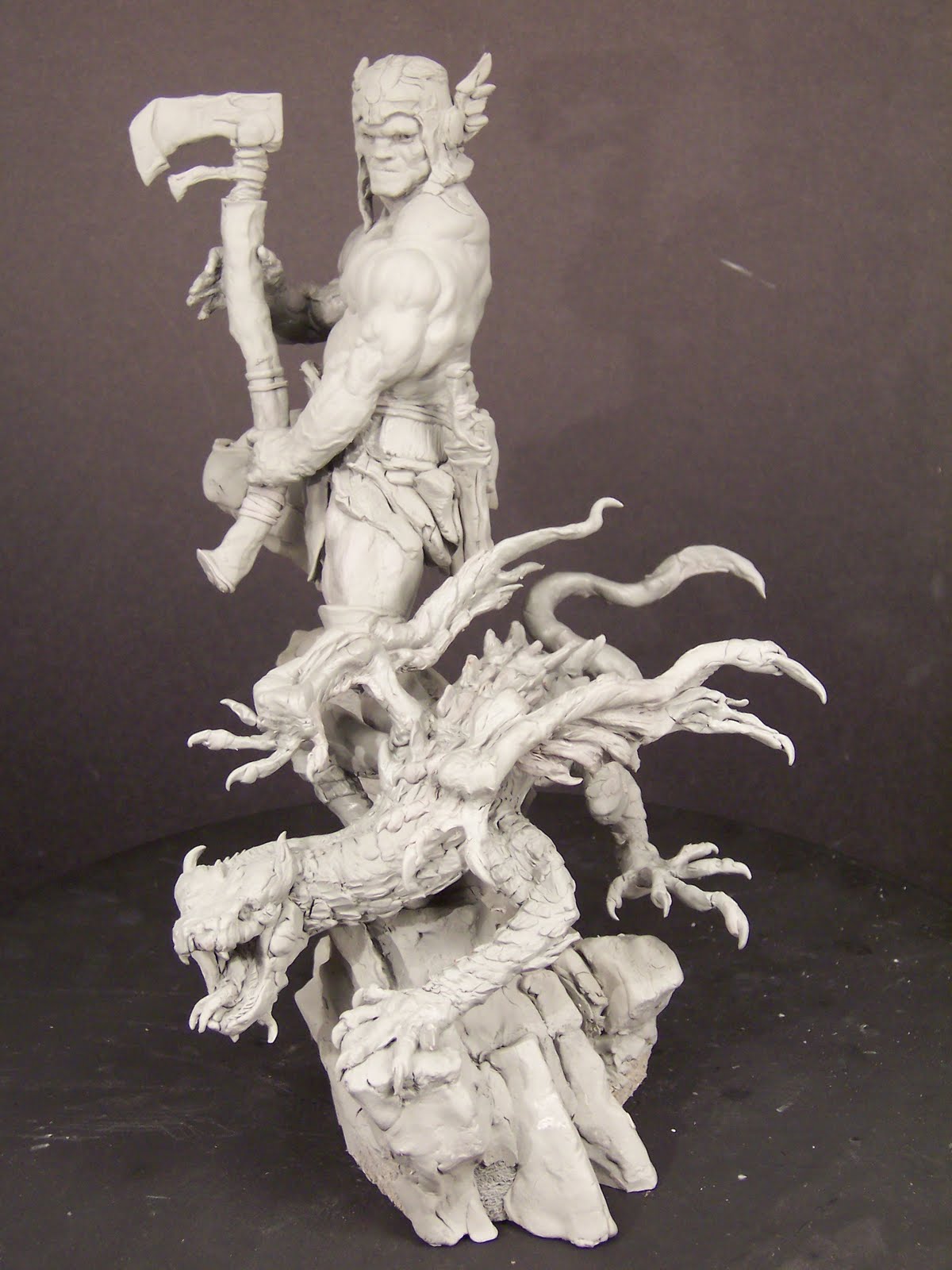
In this lesson, the focus shifts to sculpting the dragon as an integrated compositional element rather than a standalone creature. The Shiflett brothers emphasize storytelling and spatial balance, designing the dragon to curl protectively around the barbarian like a loyal animal while directing its aggression outward toward the viewer. Early decisions center on pose, scale, and flow, particularly keeping the dragon’s head low and the tail contained within the visual frame so it reinforces the composition rather than competing with the main figure. Structural considerations include the use of floral wire for support, a reinforced Bondo core in high-stress areas such as the head, and surface preparation with scoring and petroleum jelly to ensure proper adhesion of Super Sculpey. The lesson highlights an exploratory, iterative approach in which forms evolve through constant adjustment, prioritizing expressive gesture, silhouette, and narrative energy over a hyper-polished surface finish.
Duration: 18m 56s

The Shiflett brothers begin placing the accessories and wings while continually reassessing the sculpture’s overall composition and readability. They stress the importance of stepping away from the piece, viewing it from multiple distances and angles, and even photographing it to ensure the pose and silhouette remain effective when reduced visually. The helmet is developed as both a design feature and a problem-solving tool, reinforcing character identity while concealing structural imperfections. The lesson concludes with the addition of the dragon’s wings, keyed separately to simplify future casting and adjustment, reinforcing the idea that strong sculptural design emerges through iteration, distance, and continual evaluation of the piece as a unified whole rather than a collection of isolated details.
Duration: 15m 13s

This lesson recaps the core workflow and material choices used throughout the process. The Shiflett brothers emphasize working with Super Sculpey Firm, baking at a lower temperature for a longer duration, and allowing the piece to cool undisturbed for several hours or overnight to prevent cracking. They review essential materials and tools, including aluminum and floral wire, super glue, Bondo, Vaseline, rubbing alcohol, and a small set of trusted sculpting tools. The lesson also stresses not being afraid to make small late-stage adjustments, reinforcing fragile details for durability, and maintaining a flexible, iterative mindset. Overall, it highlights patience, observation, and material understanding as key to successful sculpting.
Duration: 11m 5s

This lesson focuses on using reference effectively and refining the sculpture in its final stages. The artists emphasize that careful refinement and strong decision-making are essential not only for the sculpt itself, but for building a strong, well-edited portfolio where less is more and weaker pieces are removed. As the sculpt progresses, they continue refining anatomy, ensuring muscles connect naturally, and adding subtle details such as veins and surface variation to bring realism and life to the piece. Small adjustments, smoothing, and polishing are done carefully, sometimes with heat, while continually reevaluating the work as a whole. The emphasis remains on constant observation, thoughtful refinement, and using reference to support believable forms rather than guesswork.
Duration: 20m 22s

In the concluding lesson, the finished sculpture is presented and evaluated as a complete work. The Shiflett brothers reflect on the strength of the final composition, noting the figure’s balance, centered weight, and strong sense of presence over its core. They briefly showcase additional sculpting projects, including other figures, to illustrate variations in body type, mass, and character design. The lesson closes with acknowledgments to collaborators and The Gnomon Workshop team, emphasizing gratitude for the opportunity to share their process.
Duration: 3m 56s

Skills Covered
Who’s this Workshop for?
This workshop is designed for intermediate to advanced sculptors who want to develop professional-level skills to create comic book and fantasy statues for commercial production. Professional artists, freelance sculptors, and dedicated hobbyists seeking to elevate their work to industry standards will gain valuable insight into real-world sculpting workflows using polymer clay.
Traditional sculptors transitioning into Super Sculpey, art students exploring collectible production, and artists interested in understanding how statues are prepared for resin, porcelain, and bronze casting will also benefit. The instruction emphasizes practical decision-making, material knowledge, and production-aware techniques drawn directly from professional experience in the collectible industry.
Learning Outcomes
Upon completing this workshop, artists will gain a comprehensive understanding of the professional character sculpture process, from early concept development through final surface refinement, using techniques applied in commercial statue production.
Key skills include:
- Building durable armatures capable of supporting expressive poses and anatomically sound forms.
- Designing strong compositions that translate effectively across multiple production formats.
- Sculpting believable human and fantasy anatomy using established industry practices.
- Refining surface detail and texture to elevate the overall quality of the final piece.
- Choosing and applying the right tools and materials for efficient polymer clay workflows.
- Understanding the behavior and limitations of polymer clay to achieve reliable, professional results.
- Adjusting sculpting approaches to meet the technical requirements of bronze, porcelain, and resin casting.